Articles

When Patents Take the Samba Runway: AI and Robots at Brazilian Carnival

How technological innovation took center stage and what this reveals about the future integration of culture and technology

Brazilian Carnival is recognized as one of the world’s largest cultural manifestations, projecting Brazil onto the international stage and bringing together millions of people. Beyond the artistic spectacle featuring samba school parades, street parties, and large-scale motorized sound trucks (known as ‘trios elétricos’), the event generates billions in revenue, boosting sectors such as tourism, hospitality, transportation, and the creative economy. Its global importance extends beyond financial dimensions: Carnival serves as a cultural showcase for the country, articulating tradition, innovation, social critique, and popular identity.

Technology on the Samba Runway

Using runways to showcase inventions and trends is nothing new, but bringing robots to the “Samba Runway” during a live parade was a bold and innovative move by the Mocidade Independente de Padre Miguel samba school in 2025, with their theme “Back to the Future – There Are No Limits to Dreaming.” Wrapped in a retro-futuristic narrative, the opening committee brought cutting-edge technology to a parade traditionally performed by human dancers, integrating a humanoid robot that walked and waved to the crowd, along with two robot dogs that “celebrated” on the avenue.

The use of the human versus machine and past versus future duality addresses a theme questioning the unbridled advance of artificial intelligence and technology, contrasting it with the need to preserve the environment. The school’s green color appears as a symbol of hope and a denunciation of environmental degradation.
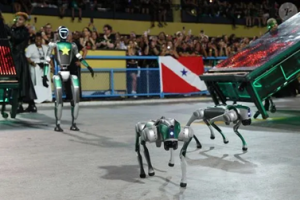
Source: PurePeople

Beyond Spectacle: A Message of Collaboration

More than a simple homage to technological progress, the parade poetically explored the relationship between past, present, and future, highlighting how the universe, the stars, and human evolution itself have always inspired us to dream higher and transform the world around us. The parade’s focus was to convey a message of hope: human creativity, represented by the samba school, can overcome difficulties and build a brilliant future through partnership between humans and machines.

It is essential to emphasize that the future lies in intelligent collaboration. AI brings bold ideas and practical solutions, enhancing capabilities that, combined with human knowledge, can improve vast areas, expanding technical capacity and generating increased productivity.
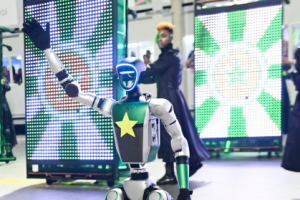
Source: CNN Brasil

Featured Patents

Examples of patented technologies for quadruped robots similar to those presented at the parade include:

US 10,940,582 B2 (Leg power system structure of electrically driven four-legged robot): A quadruped robot with exclusive leg design and independent motor assemblies for each leg, allowing greater flexibility and movement adaptability.
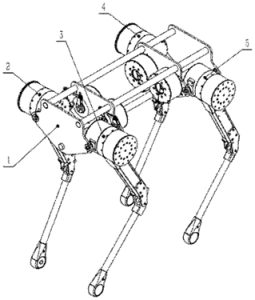
Source: US 10,940,582 B2

US 12,411,198 B2 (Robot accompaniment device and four-legged robot using the same): A robotic accompaniment device that allows the robot to accurately track and follow a person or object, enhancing its ability to assist in various tasks.
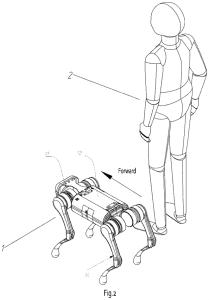
Source: US 12,411,198 B2

Carnival 2026: AI Resurrects Samba Voices

If in 2025 Mocidade brought physical robots to the avenue, Carnival 2026 promises to deepen the relationship between technology and tradition even further. Unidos do Viradouro (another prominent Rio samba school) innovated by using artificial intelligence to recreate the voice of legendary interpreter Dominguinhos do Estácio in the theme that will represent the school, marking the first application of this technology in a carnival composition.

Dominguinhos, who passed away in 2021 at age 79 and performed for Viradouro in 11 carnivals, had his voice digitally recreated for the theme “Pra Cima, Ciça” (“Go for it, Ciça!”), a tribute to drum master Moacyr da Silva Pinto. The idea emerged after a 2023 commercial that digitally brought together Brazilian music legends Elis Regina and her daughter Maria Rita.

What Comes Next?

As Lavoisier said, “Nothing is created, everything is transformed,” and in popular Brazilian culture, we adapt it to “Nothing is created, everything is copied.” The question that arises is: can we expect more patents in the 2026 parade? By bringing patented technology to Brazil’s most democratic and popular stage, Mocidade did not merely innovate: it established a precedent.

Carnival of the future has already begun!

By: Caroline Golfeto, Adriani Lima, and Larissa Veras
Articles

Protecting Human Creation

Artificial Intelligence (AI) has revolutionized the way we create and consume content, presenting significant challenges for copyright law. With AI generating texts, music, and images, we need to address who the author is, what constitutes original work, and how to protect these works legally. It is urgent to adapt our laws to ensure that human creators are fairly compensated, that original works are adequately protected, and that AI is used ethically.

Copyright in the Digital World

Copyright has always existed to protect human creativity and foster culture. But AI raises new questions:

  • What makes a work “original” if algorithms create it?
  • Who is the author of something created by a machine?
  • How do we protect the rights of those who provide data to these systems?

Current legislation, including the Brazilian Copyright Law (Law 9.610/98), still doesn’t have all the answers. Our law protects creations of the “human spirit,” which is a challenge with AI.

Fair Use and the Use of Copyrighted Works

A significant debate surrounds the use of copyrighted works to train artificial intelligence. Technology companies and copyright holders are at odds. AI often uses millions of unlicensed works, claiming “fair use.” But to what extent is this fair and legal?

The European Union is already taking action, demanding greater transparency in the use of copyrighted data. Brazil needs to follow suit.

Music and Royalties

AI is transforming the music industry, and this is affecting how artists are compensated on services like Spotify and Apple Music. Artists receive royalties based on the number of streams, and now AI-created music is competing for those streams.

The big question is: who owns the copyright and who receives the royalties for AI-created music? If an algorithm creates the music, who is the artist? The AI? The programmer? The company that developed it? Platforms are still adapting to find fair ways to compensate for “authorship,” combat fraud, and prevent unfair competition or the proliferation of low-quality music content.

Who Owns the Work Created by AI?

When an AI generates a song, text, or image, who owns the resulting work? There are four models under discussion:

  • Anthropocentric: Only humans can be authors.
  • Owner-Centric: The company that owns the AI owns the rights to it.
  • Technocentric: AI is considered the author (not yet legally accepted).
  • Hybrid: A combination of the rights of the programmer, the user, and perhaps the AI.

However, there seems to be a consensus that 100% AI-generated works cannot be protected. But we need to define clear limits for when human intervention is involved.

The consumer who unknowingly listens to a band that doesn’t exist in the real world, being led to believe it is a genuine human creation, deserves protection. The public needs to know that they will never attend a concert by these bands, nor take photos next to these imaginary singers. In these cases, the lack of transparency about the origin of the work can lead to misunderstanding, compromising the very perception of authorship and originality. Regulations must ensure clarity about AI’s participation in musical creation, allowing the public to make informed choices and protecting them from practices that devalue human artistic work.

The Future of Copyright with AI

AI is here to stay, and its relationship with copyright needs to be balanced. We need laws that protect human creators from the unauthorized use of their works (even as inspiration for AI).

I fear this could leverage and advance other art forms, such as the authorship of books, soap operas, series, and films in which the authors and actors are created solely by AI.

We need to create innovative regulations that ensure technology advances without devaluing human intellectual labor. Perhaps automated creativity can usher in a new era of collaboration between humans and machines, but this must be done with fairness and balance.

Articles

World Intellectual Property Day: Find out why this date is celebrated today.

In 2000, the World Intellectual Property Organization (WIPO) member states established a significant date on our calendars: April 26th. This choice was not random; it marks the day on which the WIPO Convention came into force in 1970, giving rise to what we celebrate today as World Intellectual Property Day. The purpose behind this designation is noble: to promote a broader and deeper understanding of the importance of intellectual property (IP) in our contemporary world.

As we observe this celebratory day, it is timely to reflect on IP’s crucial role in the global arts scene and in advancing technological innovation worldwide.

IP goes far beyond merely protecting ideas; it is essential for creativity to flourish. In the arts, the protection offered by intellectual property to creators’ rights encourages the production of new works and ensures that artists are reasonably recognized and rewarded for their talent. Intellectual property is fundamental.

Furthermore, IP plays a vital role as a catalyst for technological innovation. Protecting the discoveries and creations of engineers, scientists, and inventors fosters progress and drives the advancement of society. From patents that drive medical advances to trademarks that shape the business landscape, IP is an essential engine for our journey toward a brighter future.

Therefore, on this World Intellectual Property Day, it is imperative to not only celebrate the achievements of the past but also recognize the continued importance of IP in shaping the contemporary world. It is an opportunity to pay tribute to creators, innovators, and all those who contribute to enriching our world with their creativity and driving humanity’s progress.

Happy World Intellectual Property Day!

Artificial Intelligence
Articles, Tavares IP

Artificial Intelligence: Challenges and Opportunities Presented in the Intellectual Property

Let’s delve into the fascinating world of Artificial Intelligence (AI) and its implications for intellectual property rights. As an integral part of the modern business landscape, AI is reshaping how we process and analyze data across various industries. However, its rapid evolution brings challenges and opportunities, especially concerning data protection, trade secrets, and intellectual property rights.

Understanding the Risks and Potential of Artificial Intelligence

Recent developments in AI technology, particularly generative tools like ChatGPT, Claude, and Bard, have caught the attention of enterprise risk executives worldwide. Their inclusion in the top 10 risks of a recent Gartner survey highlights the mounting concerns around these technologies.

The Intellectual Property Quandary

One significant issue is the inadvertent inclusion of data into AI training sets. When businesses input data into generative AI tools, there’s a risk this information could be exposed or even unintentionally infringe upon intellectual property rights. This scenario necessitates a deep understanding and transparency in using AI tools to safeguard sensitive data.

Data Privacy in the Artificial Intelligence Era

Data privacy has also come into sharp focus with generative AI. These tools can unintentionally disseminate data that may reveal trade secrets or confidential information. This concern has prompted stricter data protection regulations in various jurisdictions, including Brazil, China, the EU, the US, Canada, India, and the UK.

Cybersecurity: A Double-Edged Sword

The susceptibility of generative AI to cyber threats such as malware and sophisticated phishing attacks cannot be overlooked. Yet, paradoxically, AI also enhances cybersecurity measures. By detecting and responding to threats more efficiently than traditional systems, AI proves to be a formidable ally in data protection.

Ethical Considerations in Artificial Intelligence Deployment

The deployment of AI in data analysis and information discovery raises ethical concerns, mainly when used for purposes like industrial espionage or in ways that could violate privacy and stifle innovation. Companies must weigh the risks against the benefits, adopting comprehensive cybersecurity practices and staying abreast of relevant regulations and ethical considerations.

Real-World Applications and Legal Complexities

The transformative potential of AI in business operations is undeniable. For instance, Tavares IP employs AI to automate tasks and prevent its clients’ intellectual property from being infringed. Similarly, Microsoft’s implementation of content filters in Copilot reflects the industry’s proactive stance in addressing these challenges. However, legal disputes, such as the copyright lawsuit against GitHub Copilot, highlight companies’ intricate legal responsibilities in ensuring their AI technologies respect intellectual property rights and do not violate existing content.

Conclusion

Artificial Intelligence undoubtedly offers tremendous advantages in data processing and business automation. Yet, it simultaneously introduces significant intellectual property, data privacy, and cybersecurity challenges. As we navigate this evolving landscape, companies must address these challenges responsibly. Compliance with regulations, ethical standards, and a balanced approach to leveraging AI’s potential is essential to protect and enhance business operations in this digital age.

Stay tuned to our blog or our Instagram and LinkedIn for more insights and legal expertise in the ever-evolving world of AI and intellectual property. Your thoughts and comments are always welcome!

Privacy Overview

This website uses cookies so that we can provide you with the best user experience possible. Cookie information is stored in your browser and performs functions such as recognising you when you return to our website and helping our team to understand which sections of the website you find most interesting and useful.