Brazil’s Congress fast-tracks bill on compulsory licensing of Mounjaro patents
News

Brazil’s Congress fast-tracks bill on compulsory licensing of Mounjaro patents

On Monday (9), Brazil’s Chamber of Deputies approved, by 337 votes to 19, an urgent procedure for a bill that allows the compulsory licensing of patents related to Mounjaro and Zepbound. The approval places the proposal on a fast-track, bypassing committee review and moving directly to a plenary vote.

The medications are used to treat type 2 diabetes and obesity, and the bill seeks to amend Brazil’s intellectual property framework to allow compulsory licenses for public-interest purposes.

Rationale behind the proposal

According to the bill’s justification, the high market prices of these drugs prevent their large-scale adoption, particularly in public health policies. The author argues that the current cost structure is incompatible with mass treatment strategies in a country with more than 200 million inhabitants, many of whom could benefit from such therapies.

The proposal also highlights that Brazil’s public healthcare system (SUS) is unable to absorb these medicines due to their elevated cost.

Parallel initiative in the Senate

A similar initiative is currently under discussion in the Brazilian Senate. The bill proposes a temporary suspension of the tirzepatide patent, the active ingredient in Mounjaro, on public-interest grounds. The proposal includes provisions for local manufacturing and expanded access to obesity treatment within the public healthcare system.

IP implications

These legislative initiatives revive discussions on the balance between patent protection and public health policies, particularly in the pharmaceutical sector. If approved, compulsory licensing measures may significantly impact patent strategies, pricing models, technology transfer agreements, and investment decisions in Brazil.

Articles

When Patents Take the Samba Runway: AI and Robots at Brazilian Carnival

How technological innovation took center stage and what this reveals about the future integration of culture and technology

Brazilian Carnival is recognized as one of the world’s largest cultural manifestations, projecting Brazil onto the international stage and bringing together millions of people. Beyond the artistic spectacle featuring samba school parades, street parties, and large-scale motorized sound trucks (known as ‘trios elétricos’), the event generates billions in revenue, boosting sectors such as tourism, hospitality, transportation, and the creative economy. Its global importance extends beyond financial dimensions: Carnival serves as a cultural showcase for the country, articulating tradition, innovation, social critique, and popular identity.

Technology on the Samba Runway

Using runways to showcase inventions and trends is nothing new, but bringing robots to the “Samba Runway” during a live parade was a bold and innovative move by the Mocidade Independente de Padre Miguel samba school in 2025, with their theme “Back to the Future – There Are No Limits to Dreaming.” Wrapped in a retro-futuristic narrative, the opening committee brought cutting-edge technology to a parade traditionally performed by human dancers, integrating a humanoid robot that walked and waved to the crowd, along with two robot dogs that “celebrated” on the avenue.

The use of the human versus machine and past versus future duality addresses a theme questioning the unbridled advance of artificial intelligence and technology, contrasting it with the need to preserve the environment. The school’s green color appears as a symbol of hope and a denunciation of environmental degradation.
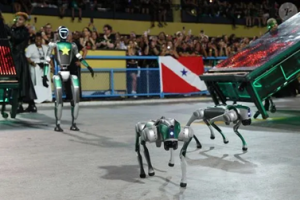
Source: PurePeople

Beyond Spectacle: A Message of Collaboration

More than a simple homage to technological progress, the parade poetically explored the relationship between past, present, and future, highlighting how the universe, the stars, and human evolution itself have always inspired us to dream higher and transform the world around us. The parade’s focus was to convey a message of hope: human creativity, represented by the samba school, can overcome difficulties and build a brilliant future through partnership between humans and machines.

It is essential to emphasize that the future lies in intelligent collaboration. AI brings bold ideas and practical solutions, enhancing capabilities that, combined with human knowledge, can improve vast areas, expanding technical capacity and generating increased productivity.

Source: CNN Brasil

Featured Patents

Examples of patented technologies for quadruped robots similar to those presented at the parade include:

US 10,940,582 B2 (Leg power system structure of electrically driven four-legged robot): A quadruped robot with exclusive leg design and independent motor assemblies for each leg, allowing greater flexibility and movement adaptability.
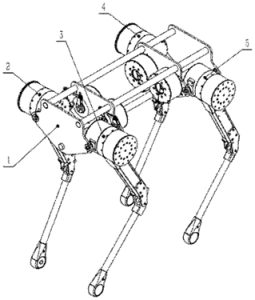
Source: US 10,940,582 B2

US 12,411,198 B2 (Robot accompaniment device and four-legged robot using the same): A robotic accompaniment device that allows the robot to accurately track and follow a person or object, enhancing its ability to assist in various tasks.
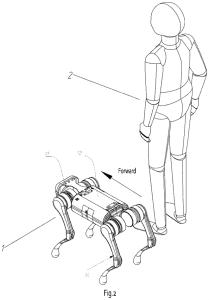
Source: US 12,411,198 B2

Carnival 2026: AI Resurrects Samba Voices

If in 2025 Mocidade brought physical robots to the avenue, Carnival 2026 promises to deepen the relationship between technology and tradition even further. Unidos do Viradouro (another prominent Rio samba school) innovated by using artificial intelligence to recreate the voice of legendary interpreter Dominguinhos do Estácio in the theme that will represent the school, marking the first application of this technology in a carnival composition.

Dominguinhos, who passed away in 2021 at age 79 and performed for Viradouro in 11 carnivals, had his voice digitally recreated for the theme “Pra Cima, Ciça” (“Go for it, Ciça!”), a tribute to drum master Moacyr da Silva Pinto. The idea emerged after a 2023 commercial that digitally brought together Brazilian music legends Elis Regina and her daughter Maria Rita.

What Comes Next?

As Lavoisier said, “Nothing is created, everything is transformed,” and in popular Brazilian culture, we adapt it to “Nothing is created, everything is copied.” The question that arises is: can we expect more patents in the 2026 parade? By bringing patented technology to Brazil’s most democratic and popular stage, Mocidade did not merely innovate: it established a precedent.

Carnival of the future has already begun!

By: Caroline Golfeto, Adriani Lima, and Larissa Veras

Brazilian PTO updates Industrial Designs Manual and tightens priority rules
News

Brazilian PTO updates Industrial Designs Manual and tightens priority rules

On January 22, 2026, the Brazilian Patent and Trademark Office (BPTO) released an updated version of its Industrial Designs Manual, introducing important changes to the examination of priority claims in industrial design applications.

The key change allows the BPTO to declare a loss of priority without issuing a prior office action in certain situations, marking a shift from prior administrative practice.

Cases where priority may be lost without prior action

Under the updated guidelines, priority may be automatically lost when:

  • the priority document contains a design unrelated to the Brazilian application, and the correct document is not submitted within 90 days;
  • a valid priority document, including figures, application number, and filing date in the country of origin, is not submitted within the 90-day statutory deadline; or
  • the figures in the Brazilian application do not fully correspond to those in the priority document.

Situations where an office action still applies

The BPTO will continue to issue office actions in cases such as:

  • illegible or incomplete priority documents;
  • discrepancies between the applicants or owners listed in the Brazilian filing and the priority document; or
  • poor-quality figures that prevent proper comparison between the claimed design and the priority filing.

Legal basis and practical impact

The update aligns the Manual with the Brazilian Industrial Property Law (Law No. 9,279/1996), particularly Articles 16 and 99. It reflects the conclusions of Legal Opinion No. 00016/2023, which emphasizes strict compliance with administrative deadlines.

While the new approach is more stringent, applicants’ right to appeal remains fully preserved.

Overall, the changes aim to improve exam efficiency, eliminate procedural inconsistencies, and enhance legal certainty and predictability for industrial design applicants in Brazil.

News

Brazil and the EU strengthen cross-border data transfers

Brazil and the European Union have announced the mutual recognition of the equivalence of their personal data protection frameworks, creating a trusted legal basis for cross-border data transfers between the two jurisdictions.

The decision acknowledges that both systems ensure high and reliable standards of privacy protection, providing legal certainty for international data flows related to economic activities, digital services, scientific cooperation, and global platform operations.

From a regulatory perspective, the agreement is expected to reduce compliance burdens, enhance legal predictability, and foster digital trade and investment between Brazil and the EU. Government officials emphasized that strong data protection standards are not obstacles to innovation, but rather a cornerstone of a sustainable and trustworthy digital economy.

The measure also highlights the growing alignment between Brazil’s General Data Protection Law (LGPD) and the EU’s General Data Protection Regulation (GDPR), a key issue for companies handling personal data across borders.

Bill proposes protection for long-term trademark use without registration in Brazil
News

Bill proposes protection for long-term trademark use without registration in Brazil

Bill No. 512/25, currently under review by the Brazilian Chamber of Deputies, proposes amendments to the Brazilian Industrial Property Law to protect the use of trademarks that have been used continuously and in good faith over time, even without formal registration.

Under the proposal, trademark coexistence may be allowed when:

  • the mark has been used for a prolonged period without opposition;
  • there is a significant geographic distance between the businesses;
  • the registered trademark owner failed to act promptly;
  • no financial harm or likelihood of consumer confusion is demonstrated.

according to the author of the text, Congressman Jonas Donizette, the measure aims to enhance legal certainty for micro and small businesses, which often develop well-established local brands but later face claims from trademark owners who do not operate in the same region.

The bill also references recent case law from the São Paulo Court of Appeals (TJSP), which allowed the coexistence of identical trademarks used by pizzerias in different cities, based on over 30 years of good-faith use and the trademark owner’s delay in enforcing its rights.

If enacted, the proposal may significantly influence trademark enforcement strategies in Brazil, particularly in disputes involving prior use, good faith, and the territorial scope of trademark rights.

The bill is subject to conclusive review by the Industry, Commerce and Services Committee and the Constitution and Justice Committee.

Privacy Overview

This website uses cookies so that we can provide you with the best user experience possible. Cookie information is stored in your browser and performs functions such as recognising you when you return to our website and helping our team to understand which sections of the website you find most interesting and useful.