How technological innovation took center stage and what this reveals about the future integration of culture and technology
Brazilian Carnival is recognized as one of the world’s largest cultural manifestations, projecting Brazil onto the international stage and bringing together millions of people. Beyond the artistic spectacle featuring samba school parades, street parties, and large-scale motorized sound trucks (known as ‘trios elétricos’), the event generates billions in revenue, boosting sectors such as tourism, hospitality, transportation, and the creative economy. Its global importance extends beyond financial dimensions: Carnival serves as a cultural showcase for the country, articulating tradition, innovation, social critique, and popular identity.
Technology on the Samba Runway
Using runways to showcase inventions and trends is nothing new, but bringing robots to the “Samba Runway” during a live parade was a bold and innovative move by the Mocidade Independente de Padre Miguel samba school in 2025, with their theme “Back to the Future – There Are No Limits to Dreaming.” Wrapped in a retro-futuristic narrative, the opening committee brought cutting-edge technology to a parade traditionally performed by human dancers, integrating a humanoid robot that walked and waved to the crowd, along with two robot dogs that “celebrated” on the avenue.
The use of the human versus machine and past versus future duality addresses a theme questioning the unbridled advance of artificial intelligence and technology, contrasting it with the need to preserve the environment. The school’s green color appears as a symbol of hope and a denunciation of environmental degradation.
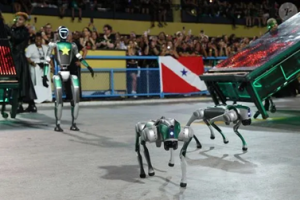 Source: PurePeople
Beyond Spectacle: A Message of Collaboration
More than a simple homage to technological progress, the parade poetically explored the relationship between past, present, and future, highlighting how the universe, the stars, and human evolution itself have always inspired us to dream higher and transform the world around us. The parade’s focus was to convey a message of hope: human creativity, represented by the samba school, can overcome difficulties and build a brilliant future through partnership between humans and machines.
It is essential to emphasize that the future lies in intelligent collaboration. AI brings bold ideas and practical solutions, enhancing capabilities that, combined with human knowledge, can improve vast areas, expanding technical capacity and generating increased productivity.
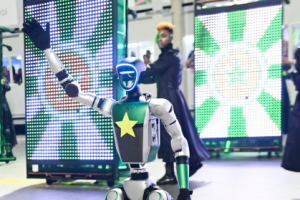 Source: CNN Brasil
Featured Patents
Examples of patented technologies for quadruped robots similar to those presented at the parade include:
US 10,940,582 B2 (Leg power system structure of electrically driven four-legged robot): A quadruped robot with exclusive leg design and independent motor assemblies for each leg, allowing greater flexibility and movement adaptability.
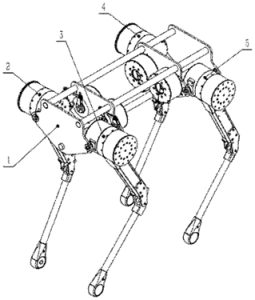 Source: US 10,940,582 B2
US 12,411,198 B2 (Robot accompaniment device and four-legged robot using the same): A robotic accompaniment device that allows the robot to accurately track and follow a person or object, enhancing its ability to assist in various tasks.
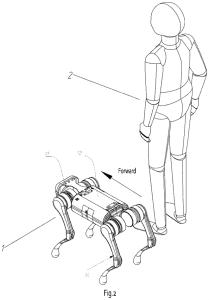 Source: US 12,411,198 B2
Carnival 2026: AI Resurrects Samba Voices
If in 2025 Mocidade brought physical robots to the avenue, Carnival 2026 promises to deepen the relationship between technology and tradition even further. Unidos do Viradouro (another prominent Rio samba school) innovated by using artificial intelligence to recreate the voice of legendary interpreter Dominguinhos do Estácio in the theme that will represent the school, marking the first application of this technology in a carnival composition.
Dominguinhos, who passed away in 2021 at age 79 and performed for Viradouro in 11 carnivals, had his voice digitally recreated for the theme “Pra Cima, Ciça” (“Go for it, Ciça!”), a tribute to drum master Moacyr da Silva Pinto. The idea emerged after a 2023 commercial that digitally brought together Brazilian music legends Elis Regina and her daughter Maria Rita.
What Comes Next?
As Lavoisier said, “Nothing is created, everything is transformed,” and in popular Brazilian culture, we adapt it to “Nothing is created, everything is copied.” The question that arises is: can we expect more patents in the 2026 parade? By bringing patented technology to Brazil’s most democratic and popular stage, Mocidade did not merely innovate: it established a precedent.
Carnival of the future has already begun!
By: Caroline Golfeto, Adriani Lima, and Larissa Veras